Methodology

The Cyber Value Arc

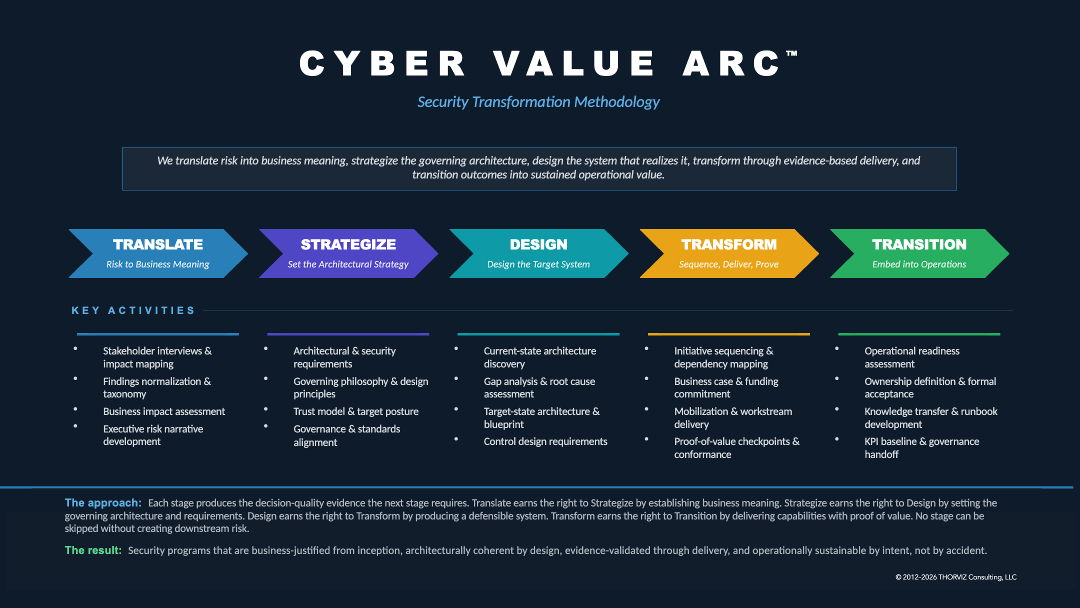
A five-phase cybersecurity transformation methodology — forged in practice across years of enterprise engagements. It is how THORVIZ scopes, executes, and transitions every engagement.

The Arc · Five Phases

Our Cyber Value Arc works because it was forged in practice, not theory. When we execute it, security investments translate into measurable business outcomes — justified, delivered, and sustained.

The Five Phases

From ambiguity to operational reality.

Each phase produces specific, defensible outputs. Each phase closes a kind of gap that most security programs leave open. Together, they form a continuous arc from business intent to sustained operational capability.

Phase 01

Translate

Risk to Business Language

Security initiatives fail at inception when they begin in control language rather than business language. Translate reframes security and risk in terms that executives can reason about, prioritize, and authorize — turning ambiguous concern into a decision-ready problem statement.

This phase establishes the business justification layer. Without it, every subsequent phase becomes a negotiation for legitimacy.

Key Outcomes
  • Risk framed in business decision language
  • Stakeholders aligned on priorities
  • Decision-ready problem statement
Phase 02

Design

Architect the Response

A defensible target-state architecture — not a list of controls. Design produces the structural response to the validated risk: systems, identity, data flow, and trust boundaries arranged so that security is a property of the architecture, not an attachment to it.

Every gap is traced back to a validated risk. Every design decision is implementation-ready.

Key Outcomes
  • Defensible target-state architecture
  • Every gap traced to a validated risk
  • Implementation-ready design basis
Phase 03

Strategize

Engineer the Transformation

Architecture without investment logic is a blueprint with no foundation. Strategize engineers the path from target-state design to funded, executable transformation — with clear rationale for what happens now, what happens next, and what is deliberately deferred.

Ownership is assigned. Dependencies are made visible. Pace is set by capacity, not by ambition.

Key Outcomes
  • Funded, sequenced transformation roadmap
  • Dependencies visible and owned
  • Clear now / next / later rationale
Phase 04

Transform

Deliver with Evidence

Delivery aligned to architectural intent, not to ticket volume. Transform operationalizes the roadmap through structured execution, producing evidence of value as it is delivered — not as a retrospective claim at closeout.

Capabilities land with proof. Drift from the design basis is detected and corrected in flight.

Key Outcomes
  • Capabilities delivered with evidence
  • Execution aligned to architecture intent
  • Value proven during delivery, not after
Phase 05

Transition

Embed into Operations

A security capability that cannot be run by operations is a capability that will quietly decay. Transition closes the engagement arc with clean ownership handoff, sustainable steady-state governance, and a defined path for continuous improvement.

The engagement ends. The capability continues.

Key Outcomes
  • Clean ownership transfer to operations
  • Sustainable steady-state governance
  • Continuous improvement path defined
Why It Works
Security programs that are business-justified from inception, architecturally coherent by design, strategically engineered, evidence-validated through delivery, and operationally sustainable by intent — not by accident.

The Cyber Value Arc is the codified discipline behind that result. It is how THORVIZ scopes an engagement, structures execution, and determines when the work is done.